
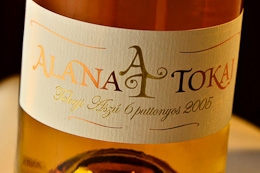
WHY ALANA-TOKAJ?


Because it is the newest leading artisanal source for beautiful,

completely natural Tokaji offered to wine-lovers in the US.


The estate's first Aszu wine, the 2005, received 95 points

from Wine Spectator (2010).

The estate's first three late harvest releases,

the '05 Muscat, '06 Furmint and '06 Autumn in Tokaj,

received 92, 90 and 92 points.


ALANA-TOKAJ

received the highest inaugural release WS scores of any Tokaji winery in history.


Its 2005 6 puttonyos Aszu is also one of the top 100 highest scoring wines of 2010.


Tokaji was - without a doubt - the original crown jewel of the wine world for three centuries,

only to vanish from the best tables during the American Prohibition,

the European Holocaust and the Soviet occupation of Central Europe.

Tokaji's long overdue resurrection, the dream of connoisseurs,

became a reality only after the Iron Curtain fell,

and the renaissance began.


“ I adore the new-wave Tokaji, which have a stunning richness of fruit and pristine botrytis complexity,

and I thank God for the revolution...”

Tom Stevenson, The New Sotheby's Wine Encyclopedia 2001


But how do you revive the legendary quality of Tokaji?


First, you start by shaking off the compromises of the recent past - by throwing away

its books about "efficient" grapegrowing and wine-making.

Then you dedicate your faith to the vineyard, respecting the wisdom of the ancestors,

who first recognized the greatness of these classified sites back in the 1500s.

Finally, just like they did,

you refuse any and all shortcuts in order to make the most natural and most delicious wine you can.


betsek

Please click on image "Betsek"


You push back to traditional ultra-low yields, below those of Yquem,

and return to extreme late harvest, still working in late December, when around the globe

all others have already left the vines. You never purchase or contract grapes.


You also hold yourself to a higher standard than others and use no added sugar, no added acidity or added alcohol, no freezing, drying, cooking or pasteurizing, no added yeast or enzymes, no added flavors and no added water. You restrict yourself to applying the smallest amount of natural sulfur. In the vineyards you use no fertilizers at all, never any herbicide, no irrigation, no yields above 3 barrels/acre, no flat valley vineyards, no genetically modified vines, no machine pruning or harvesting, and no chemicals beyond environmentally acceptable compounds ...


In other words, no compromise in the vineyard and no secrets behind closed doors in the cellar.


aszuberriesarrive

Please click on image to enlarge


In return, what you get - and what we got - is the gift of exquisite grapes and

the rebirth of tremendous wines.

The wines already speak volumes of what is possible if you have the right approach and dedication.

Above all, they are just what you would expect them to be:

unique, pure and delicious.


“...the famous sweet aszus, which are some of my favourite wines ... I have long enjoyed the rare delights of

older vintages and now admire the new.”


“Tokaj is ... undoubtedly the least well-known of all the great wines in the world."


"It is safe to say that Tokaji Aszu is the first ... of the great sweet wines,

well established as such by the mid-17th century. The beneficial effects of botrytis were noted here

almost a century before they were accidentally discovered in Germany. Moreover, the vineyards were

the first ever to be classified;

in 1700 Prince Rakoczi of Transylvania introduced 1st 2nd and 3rd class (or growth) quality ratings.

Tokaj was the most highly regarded and sought after wine..."


After tasting the 1811:

"It is the only wine I have ever tasted which did not have a "finish". It just went on and on."

(6 out of 5 stars)


Michael Broadbent,, Vintage Wine, 2002


The blessings of Botrytis


aszu

Please click on image "botrytis"


Everything we do, every day in our vineyards, is to prepare our grapes for

a magical transformation, the natural wonder of botrytis.

The noble rot, so cherished around the globe for its powers to yield the greatest sweet wines,

must find our vineyards the kindest in the world,

since it visits them more frequently than any other on the planet,

returning without fail every year, especially to grapes in our Betsek and Veresek vineyards.


To deserve this gift, we work hard all year.

We hand prune, hand till all season, and hand harvest all of our grapes.

We rack and bottle every drop of our wine by hand.


"You certainly own a lot of fabled acreage, I must say.

I don't ever receive invitations from unknown new Burgundy vintners like that

(Oh, we own 3 hectares of Richebourg, 7 Grands Echezeaux, 10 Beauxmonts...")!


David Schildknecht, The Wine Advocate, 2006, letter to Alana-Tokaj


Our vines grow on:

22 acres (8.8 hectares) on the first class slope of Betsek,

6 acres (2.4 hectares) in the first class Kiraly vineyard,

25.5 acres (10.3 hectares) in Veresek,

and a few small first class experimental plots.


Our average yield is 2 barrels of sweet wine per acre, or 4.5 barrels of 60 gallons per hectare.

On each hectare we grow 5,000 vines, at low and medium height, close to the Earth's warmth.


Each glass of our wine represents the concentrated essence of an entire vine.


"Late frosts in the spring of the year, wet summers, and heavy hail-storms all lend their aid

in relieving the monotony of always having successful seasons, and heavy taxes make the raising of grapes

anything but an absolute pleasure. In some respects the progress has not been rapid,

and primitive methods are still to be found,

but if Hungary never gives the world another boon she can forever rest upon her laurels

in having produced Tokay.

It is not Hungary that has made Tokay famous but Tokay which has made Hungary celebrated."

"Beverages, Past and Present..." by Edward Randolph Emerson, 1908


tasting

Please click on image "stages of tasting"


Having a small number of bottles born each year, bottle limits apply for certain releases.

With wine lovers journeying to our vineyards and cellar, however, we share more of our bottles,

to reward their travel and dedication to our wine.


"On the whole, it is generally acknowledged,

that the wines of Tokay are superior to those of any other country in the world."

"A Philosophical and Statistical History..." by Samuel Morewood, 1838


"Let me state for the record that Tokaji is amongst the greatest wines in the world.

In fact, it could be the greatest."

"During the 19th century, Tokaji made Yquem look like “Two Buck Chuck”, coveted and eulogised

by the aristocracy and royalty for its restorative powers..."

Neal Martin, The Wine Advocate's Wine Journal, February 2010


boxes

Please click on image to enlarge


When visiting, you can also taste from our library stock encompassing all of our past releases.


Cheers and welcome!


Your friends,


Allison Tonkin, Andras Nemeth, Jr and Attila Gabor Nemeth


ALANA-TOKAJ

World Heritage Site Vineyards and Winery


©2009 ALANA-TOKAJ